
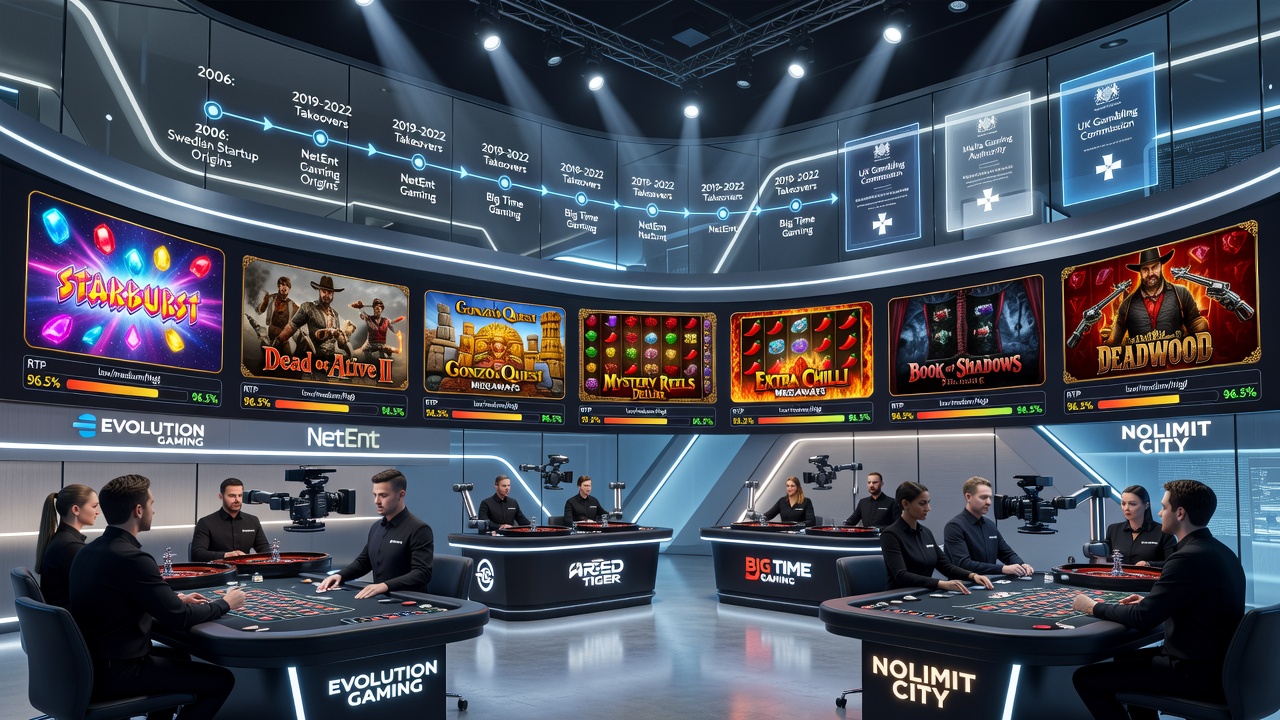
One company now sits behind a striking share of the live dealer tables and video slots found across UK online casinos, having grown from a Swedish start-up into a dominant force through acquisition rather than organic expansion alone. Evolution Gaming's rise illustrates how consolidation has reshaped the casino software industry, with implications for players, operators and regulators alike.
From Live Dealers to Industry Consolidator
Evolution was founded in Sweden in 2006 and built its reputation on live dealer technology, launching its first live roulette and blackjack products in 2007. By 2010 it had secured business-to-business licences with the UK Gambling Commission and the Malta Gaming Authority, two of the sector's more demanding regulatory bodies. That licensing step mattered: B2B certification requires software providers to meet technical and probity standards before their games can be distributed through licensed operators, giving casinos and players a baseline assurance of fairness and security.
The company's live studios, streaming real dealers in high definition, remain its signature product. But the business model changed substantially from 2019 onward, when Evolution began acquiring established slots studios rather than building out a slots division from scratch. Red Tiger joined the group in 2019, NetEnt followed in 2020, Big Time Gaming in 2021, and Nolimit City in 2022. Each brought its own back catalogue and development team, meaning Evolution absorbed decades of combined slot design experience in a short span.
Why Acquisitions Reshape the Supply Chain
Buying established studios rather than competing against them is a recognised strategy in gaming technology markets, similar to patterns seen in software and fintech more broadly. It reduces competition, consolidates distribution deals with operators, and lets the acquiring company offer a broader catalogue under one commercial relationship. For casino operators, this can simplify integration and content licensing. For regulators and players, it raises a more structural question: as fewer companies control more of the content layer, market diversity in game design and risk parameters could narrow over time, even as individual game titles remain varied.
Each subsidiary retains its own identity and mechanics. NetEnt titles like Starburst and Dead or Alive II, Red Tiger's Gonzo's Quest Megaways and Mystery Reels Deluxe, Big Time Gaming's Extra Chilli Megaways, and Nolimit City's Book of Shadows and Deadwood all carry distinct volatility profiles, return-to-player percentages and bonus mechanics. That variety is genuine, but it now operates within a single corporate structure rather than across independent competitors.
What This Means for Players
Return to Player figures, volatility ratings and maximum win multipliers are published for each game and vary considerably, from Divine Fortune's medium volatility to the high-risk profiles of Dead or Alive II or Deadwood. These figures describe long-run theoretical averages calculated over very large numbers of spins, not outcomes for any individual session. No RTP percentage or bonus feature changes the underlying mathematics of house edge, and no game mechanic guarantees recovery of losses.
- Licensed UK operators offering Evolution-linked content must provide responsible gambling tools, including deposit limits and self-exclusion options.
- Bonus offers tied to specific slots are promotional mechanisms, not indicators of better odds.
- Game availability varies by operator, since each casino negotiates separate content agreements with Evolution and its subsidiaries.
As Evolution's footprint widens, scrutiny of how such consolidated providers are regulated, and how transparently their odds and bonus terms are communicated to consumers, is likely to remain a live issue for UK gambling policy.