
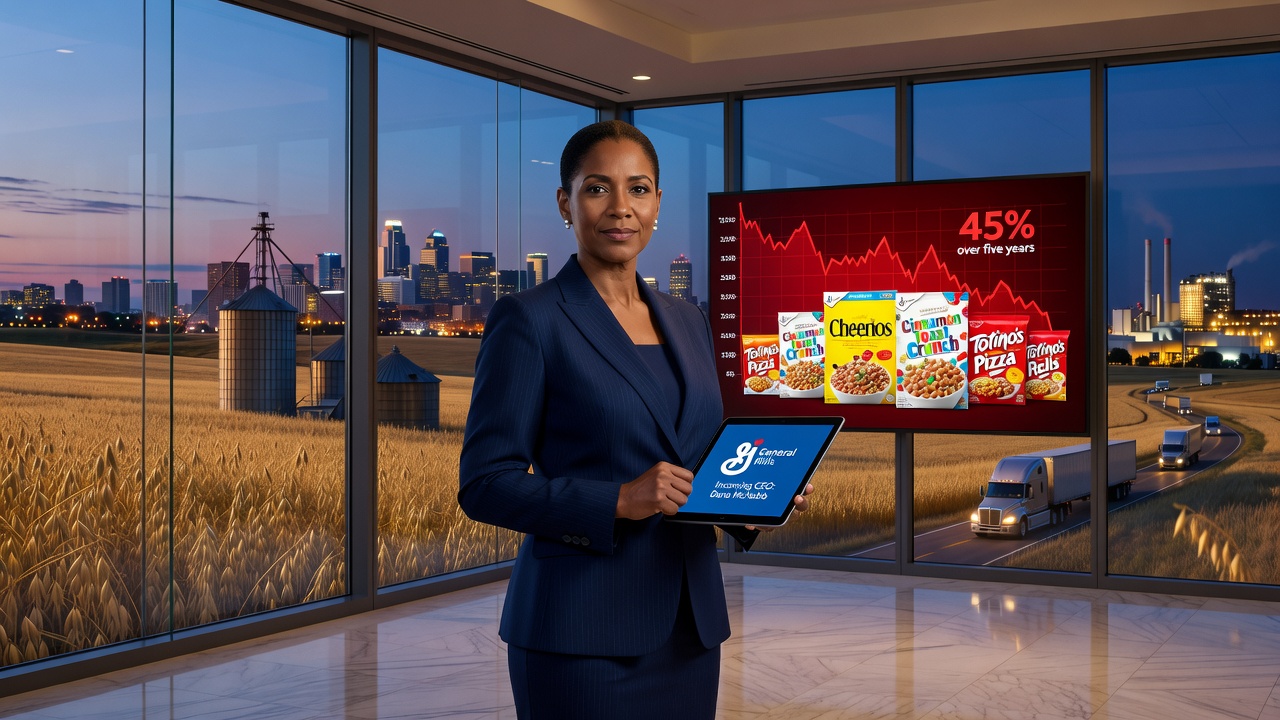
General Mills has turned to one of its own to steer the company through a prolonged sales slump. Dana McNabb, a 25-year veteran of the Minneapolis-based food giant, will become its first woman chief executive on Jan. 1, taking over from Jeff Harmening at a moment when the company's stock has fallen roughly 45% over five years.
A farm upbringing meets a corporate succession plan
McNabb's path to the top job is unusual mainly for how ordinary it looks on paper. She joined General Mills in 1999 and rotated through marketing roles across cereal, snacks, meals and dairy before leading the company's U.S. cereal unit starting in 2016. By 2021 she was chief strategy and growth officer, overseeing the "Accelerate" strategy built around acquisitions and divestitures, and in 2024 she took charge of North American retail, the company's largest business segment. That trajectory places her inside every major decision General Mills has made over the past decade, for better or worse.
Her personal framing of the job leans on a grain-farm childhood in the Canadian region that supplies most of the oats General Mills uses. Whether that biography translates into a different approach to running a packaged-food conglomerate is a separate question from whether it makes for a compelling narrative - and it is the former that investors will judge.
Why an insider pick is a calculated bet
Boards generally face skepticism when they promote from within after a stretch of weak performance, since it can signal a reluctance to change direction. Analysts tracking General Mills argue the company's problem is less about internal missteps and more about an industry-wide shift: inflation-driven price increases pushed consumers toward store brands and discount-seeking behavior, and sales volumes across the packaged-food sector have struggled to recover. General Mills has posted declining sales for three consecutive fiscal years, a pattern shared by several of its peers.
That context is why some industry observers see less risk in the insider choice than the stock chart might suggest. An external hire would still confront the same consumer who is pulling back on name-brand groceries. The real test for McNabb is execution - whether cost discipline, product reinvention and supply-chain modernization can offset a market that remains unforgiving toward legacy brands.
What McNabb says she will prioritize
McNabb has pointed to a company framework she describes as a "remarkability" tool, used to benchmark General Mills brands against competitors on packaging, pricing, promotion and in-store presentation. The company has also previously flagged a target of $3 billion in savings through 2030, generated through ongoing cost-cutting that is meant to be reinvested in product innovation rather than simply returned to margin. Recent product refreshes - including reworked pizza rolls and new cinnamon roll flavors - reflect that reinvestment approach in practice.
- Sales have declined for three straight fiscal years amid broader sector softness
- Stock price down approximately 45% over five years
- Cost-savings target of $3 billion through 2030 tied to reinvestment in innovation
- Consumers increasingly favoring store brands and discount shopping
The bigger picture for packaged food
General Mills' situation illustrates a structural challenge facing large food manufacturers rather than a company-specific failure. Pandemic-era demand gave way to inflation-driven price hikes, and consumers have not fully returned to pre-inflation buying habits. For a company built on recognizable, century-old brands like Cheerios, the shift toward value-conscious shopping tests whether brand loyalty alone can justify a price premium. McNabb's leadership will be measured less by any single product launch and more by whether the company can rebuild volume growth without eroding the margins that have historically supported its dividend and market position.