
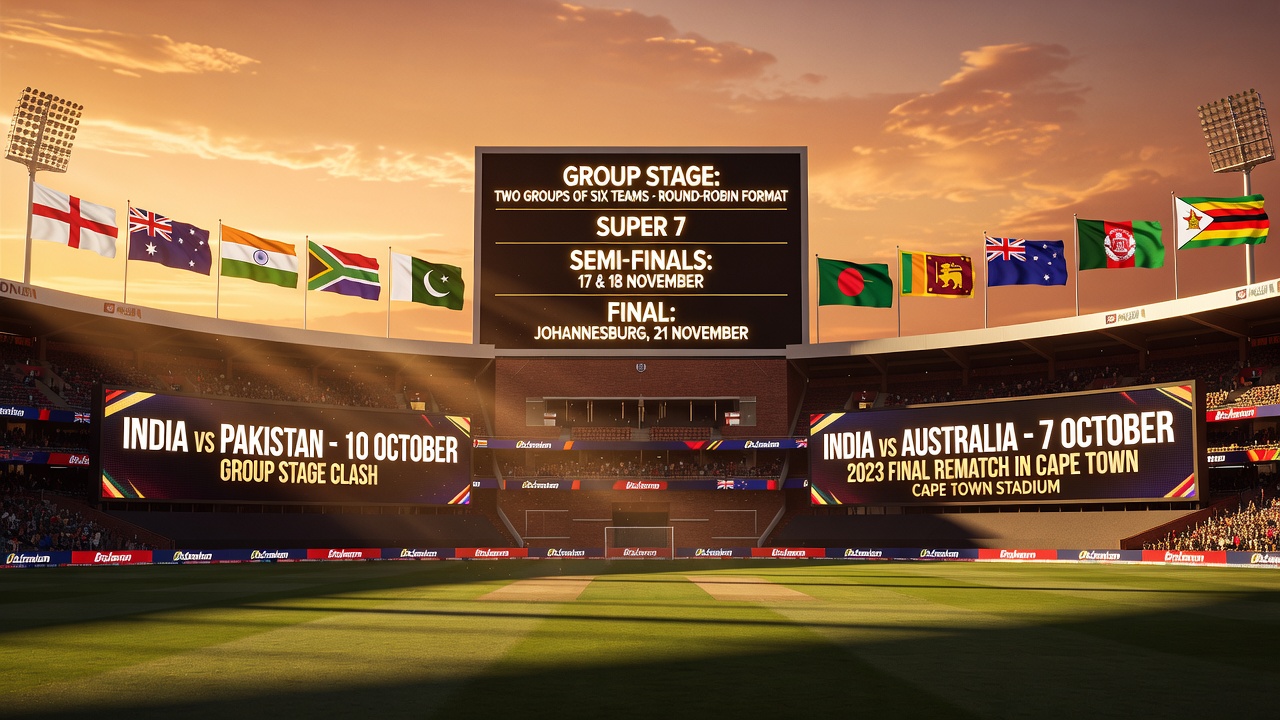
England have been kept apart from defending champions Australia and world number one-ranked India in the group-stage draw for the 2027 ICC Men's Cricket World Cup, a seeding outcome that reshapes early expectations for the tournament. The 2019 winners instead land in a group with co-hosts South Africa, Bangladesh, Sri Lanka, New Zealand and a qualifier, while India and Pakistan have again been drawn together, this time alongside Australia, Afghanistan, Zimbabwe and a qualifier.
A Familiar Flashpoint and a Historic Return
The repeat pairing of India and Pakistan guarantees one of the tournament's most scrutinised fixtures, set for Johannesburg on 10 October. The two nations do not play bilateral cricket outside global events, so this meeting carries weight well beyond the group table - it shapes broadcast scheduling, ticketing demand and the betting markets that track high-profile international fixtures closely. Group openers are notable too: the tournament begins with a rematch of the 2023 final, India against Australia in Cape Town on 7 October.
For England, the standout detail is a trip to Harare on 20 October to face a qualifier, their first visit to Zimbabwe since 2004. That gap reflects a long period of political tension rather than cricketing disinterest - England boycotted a fixture there during the 2003 World Cup, a decision that undermined their campaign at the time. Reports in 2025 suggested the respective boards had begun discussing a fuller England tour of Zimbabwe between 2027 and 2031, making this fixture a marker of warming relations rather than an isolated appearance.
Why the Draw Matters Beyond the Pitch
Group composition in a tournament of this scale influences far more than qualification odds. Broadcasters build schedules around marquee clashes, sponsors calibrate campaigns to high-interest fixtures, and markets tied to major cricket events - from traditional sportsbooks to fantasy platforms - see sharper spikes in activity around games like India versus Pakistan or India versus Australia than around lower-profile pool matches. That unevenness is a structural feature of global cricket: a handful of fixtures carry disproportionate commercial and cultural significance, and operators across media and gambling sectors plan around that reality well in advance.
England's path looks comparatively open on paper, avoiding the two highest-ranked sides in the group phase, but international tournament cricket has repeatedly shown that seeding advantages can evaporate quickly. Harry Brook's side have rebuilt credibility in the 50-over format recently, yet form heading into a tournament two years away is not a reliable predictor, and treating early draw analysis as anything more than a structural outline would be misleading.
Structure of the Path to the Final
- Two groups of six, including qualifiers, play a round-robin group stage.
- The top three in each group, plus the best fourth-placed side across both groups, advance to a Super 7 stage.
- The top four from the Super 7 progress to semi-finals, scheduled for 17 and 18 November.
- The final takes place in Johannesburg on 21 November.
This expanded format rewards early consistency while still allowing a side to recover from a difficult group game, a balance organisers have leaned on in recent editions to sustain interest - and commercial value - deep into the tournament. For England, Sri Lanka and Bangladesh open the campaign on 8 and 13 October in Windhoek, before matches against South Africa and New Zealand in Gqeberha frame the business end of their group schedule.