
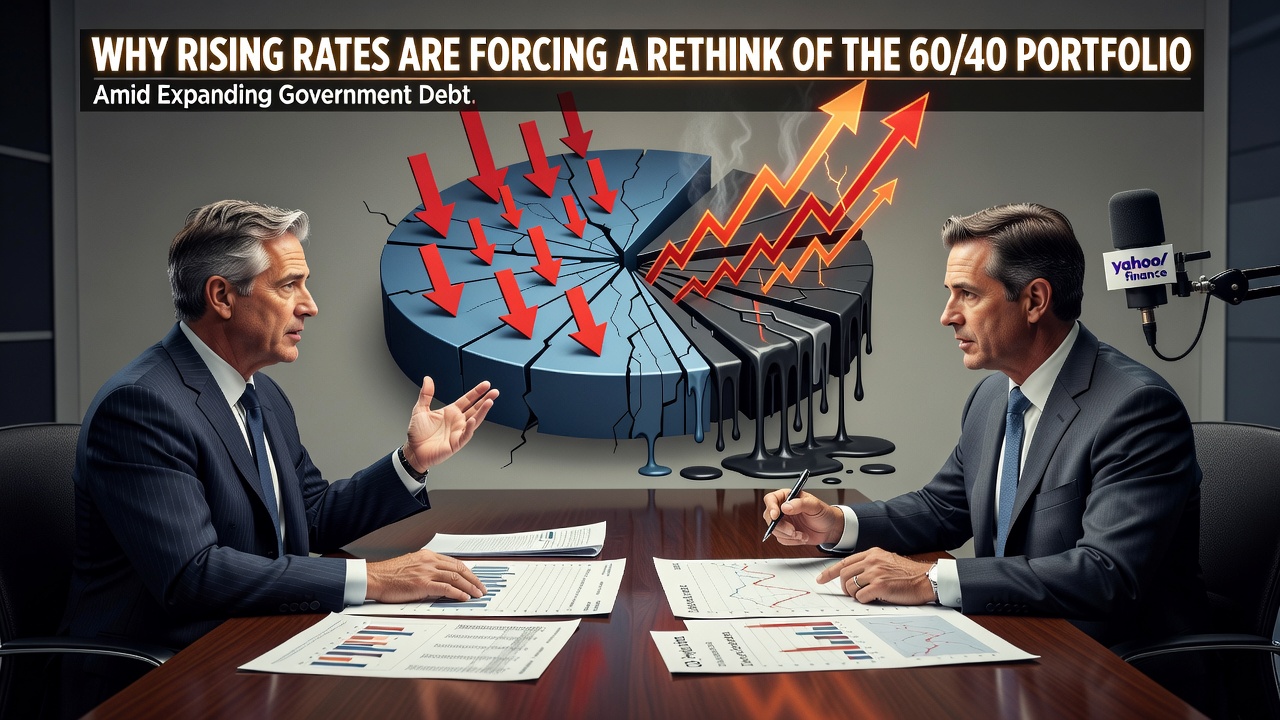
Two veteran money managers are warning that the classic 60/40 portfolio - long a default formula for balancing growth and safety - stops working when interest rates are climbing and government debt is expanding rather than contracting. David Miller, Chief Investment Officer at Catalyst Funds, and Chad Morganlander, Senior Portfolio Manager at Washington Crossing Advisors, discussed the issue on Yahoo Finance's Trader Talk, offering sharply different but complementary views on how investors should respond.
The 60/40 Model Was Built for a Different Era
The 60/40 split - 60% equities, 40% bonds - assumes stocks and bonds move in opposite directions often enough to smooth out returns. That assumption held reasonably well during decades of falling or stable rates. Miller argues the logic breaks down when rates are rising: bonds lose value as yields climb, and if equities sell off at the same time, both halves of the portfolio get hurt together rather than offsetting each other. Morganlander does not reject 60/40 outright, but frames it as suitable mainly for investors nearing or in retirement who want a transparent, low-complexity approach - high-quality, low-volatility stocks paired with a laddered bond portfolio that rolls over regularly rather than locking into long-duration debt.
When Correlations Go to One
Both guests pointed to a recurring market phenomenon: during periods of stress, asset classes that normally move independently start moving together - what Miller called "correlations going to one." In that environment, traditional diversification fails, because everything falls at once. Miller noted that credit spreads are historically tight right now, meaning the cost of borrowing for riskier companies is low relative to safer debt - a condition that tends to unwind sharply when confidence weakens, pulling multiple asset classes down simultaneously.
Alternatives Are Not All Created Equal
The conversation also tackled a term used loosely across the investment industry: alternatives. Miller distinguished between assets like real estate or private equity, which he said do not necessarily protect investors when markets fall together, and trend-following managed futures strategies, which are designed to perform specifically during periods when stocks and bonds decline in tandem. He cited his own fund's history through downturns including 2008 and 2022 as examples of that strategy type behaving as intended, while stressing that such tools are appropriate only for a portion of a sophisticated investor's allocation - not a wholesale replacement for core holdings.
Debt, Deficits, and the Path for Rates
Much of the discussion centered on the structural pressure pushing rates higher: a national debt load now measured in the tens of trillions of dollars, paired with an annual deficit that keeps adding to it. Morganlander argued that unless economic growth outpaces inflation and the deficit is addressed, that debt trajectory will keep pushing yields upward - a dynamic reinforced globally as other governments, including in Europe, pursue their own fiscal stimulus. Both noted that short-term Treasury yields are already signaling market skepticism about near-term rate cuts, putting pressure on policymakers to prove their inflation-fighting credibility through decisive action rather than rhetoric.
What This Means for Everyday Investors
The practical takeaway is less about abandoning stocks and bonds altogether and more about matching strategy to life stage and risk tolerance. Younger investors with decades to recover from volatility have more flexibility to experiment with sector-specific ETFs or alternative strategies. Those approaching retirement, both guests agreed, benefit more from simplicity: quality equities, laddered individual bonds rather than bond funds, and a clear-eyed understanding that complexity often increases risk rather than reducing it. Neither guest offered a formula promising guaranteed outcomes - only frameworks for managing uncertainty as borrowing costs and government debt levels reshape the environment investors have to navigate.