
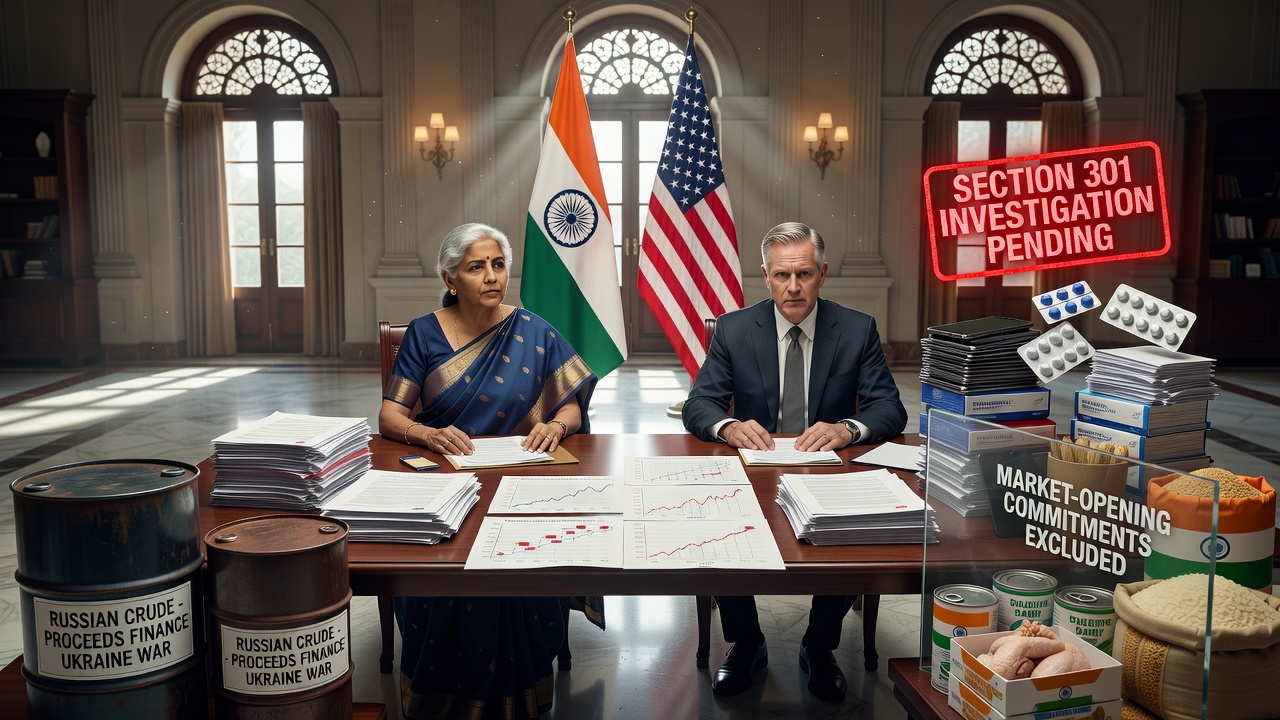
Negotiations between New Delhi and Washington on a long-sought bilateral trade agreement have hit another wall, with officials on both sides acknowledging the process has lost momentum. Finance Minister Nirmala Sitharaman described the talks as having reached a "plateau," a characterisation that came days after US Trade Representative Jamieson Greer said a deal was not "imminent." The impasse matters because it leaves one of the world's largest trading relationships exposed to tariff uncertainty just as both economies navigate a volatile global trade environment.
A Framework That Hasn't Become a Deal
The two countries agreed on a framework in February that lowered a punitive tariff on most Indian goods to 18% from 50%, a levy originally imposed last August after an earlier round of negotiations broke down. Since then, the US Supreme Court struck down President Trump's use of emergency powers to impose broad global tariffs, replacing that approach with a 10% baseline rate. Despite this legal shift and months of diplomatic engagement, a comprehensive agreement has not materialised, and neither government has offered a detailed public explanation for the delay.
Russian Oil and an Unfinished Industrial Probe
Two specific complications have emerged. First, a new US law opens the door to tariffs as high as 100% on Indian goods tied to New Delhi's continued purchases of Russian crude oil, which Washington argues helps fund the war in Ukraine. India has not meaningfully reduced those purchases, maintaining that energy sourcing decisions reflect the needs of its 1.4 billion population and that discounted Russian crude became especially important after the full-scale invasion of Ukraine disrupted global energy markets. Second, Washington has yet to conclude a Section 301 investigation into alleged excess industrial capacity across several countries, including India. Until that probe wraps up, the final tariff rate facing Indian exporters remains undetermined, complicating any effort to lock in terms.
Strained Ties Beyond Trade
Commercial friction has coincided with broader diplomatic tension. A US military strike on a vessel off Oman killed three Indian seafarers, and India has publicly rejected President Trump's repeated claims of having brokered a ceasefire between India and Pakistan. These episodes have added friction to a relationship that both governments otherwise describe as strategically important, and they help explain why trade talks have struggled to find closure even after a framework was reached.
What's at Stake for Indian Exporters
The United States remains India's largest export market, and shipments have held up so far: goods exports rose to $42.79 billion between April and August, up from $40.39 billion a year earlier, helping India run a trade surplus of nearly $34 billion with the US in fiscal year 2025/26. India notes that major export categories, including generic pharmaceuticals and smartphones, currently sit outside the 10% levy. Still, analysts caution that without a finalised deal, India faces exposure to higher tariffs once the industrial capacity probe concludes or if sanctions tied to Russian oil purchases are enforced, even as New Delhi seeks waivers. A further tariff increase could weigh on exporters, unsettle market sentiment, and add pressure to the rupee, which is already trading near record lows.
- India wants agriculture - dairy, poultry, rice and wheat - kept outside market-opening commitments.
- Washington is pressing India to scale back Russian oil imports over Ukraine war financing concerns.
- The unresolved Section 301 probe leaves the eventual tariff ceiling for Indian goods unclear.
- US Secretary of State Marco Rubio is expected in India later this month, with Modi and Trump likely to speak again before a possible December meeting at the G20.
For now, India is trying to protect politically sensitive farm sectors while pushing for tariff treatment better than rivals such as Vietnam and China. Whether upcoming diplomatic contacts can break the deadlock will shape not just trade flows, but confidence in the broader US-India relationship heading into next year.