
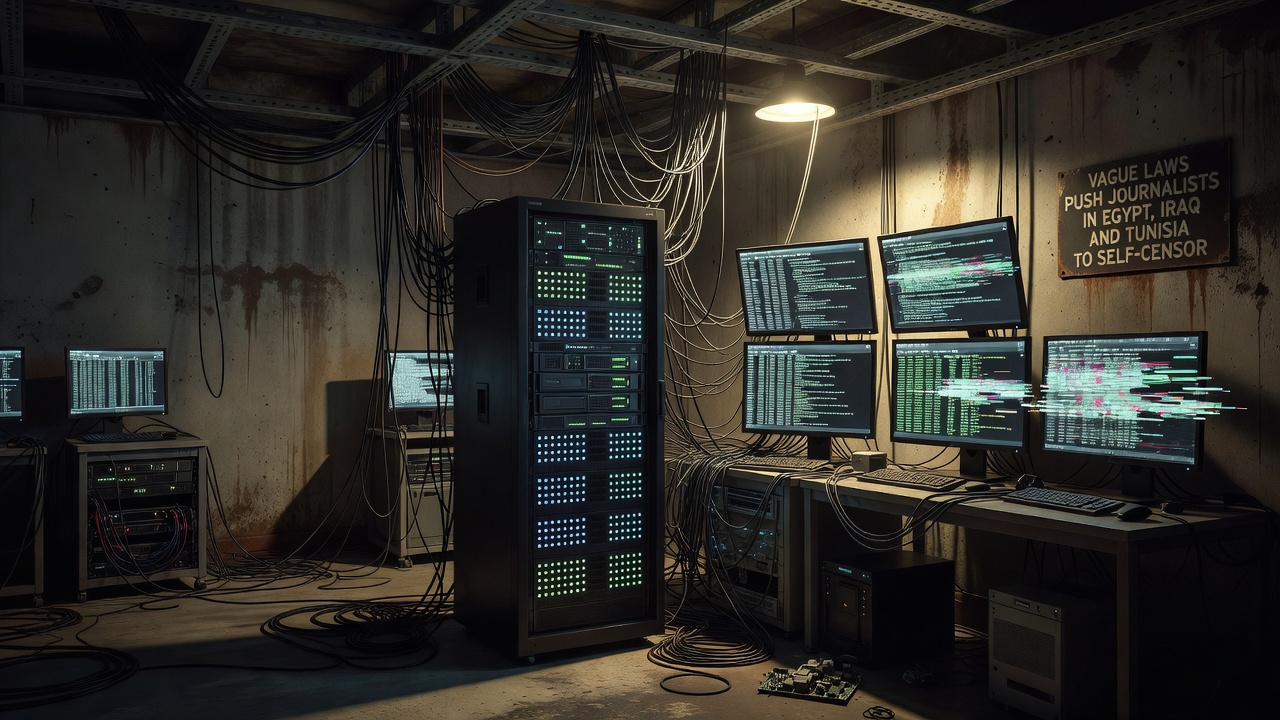
The most effective censorship tool in parts of the Middle East and North Africa right now isn't a court order or a blocked website. It's uncertainty. A year of conversations with journalists, lawyers, and digital rights defenders in Egypt, Iraq, and Tunisia points to a consistent pattern: laws written broadly enough that nobody can be sure what crosses the line, so people stop testing it.
That ambiguity does the government's work before any official has to lift a finger. Cybercrime and media laws across all three countries contain language flexible enough to criminalize almost any critical speech, from reporting on corruption to documenting protests. Lawyers describe advising clients to avoid entire categories of stories rather than risk prosecution under statutes so loosely worded that even seasoned legal teams struggle to predict how a judge might interpret them. For journalists trying to operate securely online, basic protective measures, including vpn subscription plans, encrypted messaging, and compartmentalized devices, have become standard practice rather than precautions reserved for the most sensitive assignments.
When the Threat Moves Offline
Digital harassment in these countries rarely stays digital. Doxxing campaigns, where personal information, addresses, or family details are published to intimidate, have preceded office raids and physical attacks on reporters and activists. The pattern blurs the line between online and offline risk. A threatening comment thread is no longer a nuisance to mute; it can be the opening move in a coordinated campaign that ends with a knock on the door. Activists interviewed described adjusting daily routines, travel, and even where they live based on signals picked up from social media harassment, treating online abuse as a credible predictor of real-world danger rather than background noise.
Disinformation Without Guardrails
Generative AI has made fabricated video, audio, and text cheap to produce and difficult to trace. In a region where independent fact-checking infrastructure is thin and platforms apply inconsistent moderation standards, false narratives spread well before anyone can mount a credible rebuttal. None of the three countries studied has a regulatory framework built to address synthetic media specifically, leaving journalists to debunk disinformation manually, story by story, with the same limited staff and budgets they use for original reporting. The asymmetry favors whoever is producing the false content, since generating a convincing fake takes minutes while disproving it can take days.
Funding Cuts Compound the Risk
Much of the infrastructure supporting independent journalism and digital rights work in Egypt, Iraq, and Tunisia has relied on international funding, a share of it from US foreign assistance programs. Reductions to that funding in 2025 have forced organizations to scale back legal aid, digital security training, and emergency support for people facing threats, precisely as those threats intensify. Groups that once offered rapid response when a reporter's accounts were compromised or a lawyer needed representation now face difficult choices about which cases they can still take on. The result is a widening gap between the protection people need and what's actually available to them, at a moment when the pressure from state and non-state actors alike shows no sign of easing.