
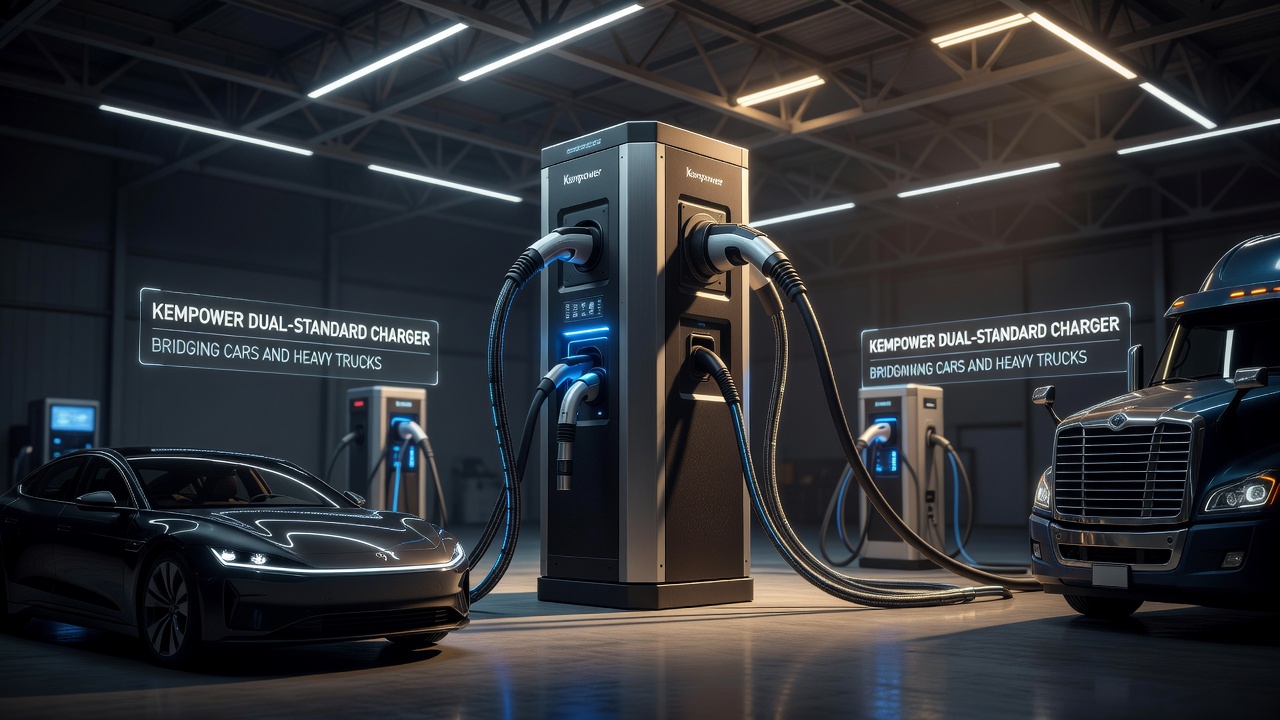
Kempower has introduced a single charging unit capable of serving both passenger electric vehicles and heavy-duty electric trucks, a design choice that could reshape how charging sites are planned in the coming years. The new Mega Satellite Flex supports the established Combined Charging System, delivering up to 560 kW, alongside the emerging Megawatt Charging System, which pushes output as high as 1.2 MW. The Finnish charging manufacturer revealed the product this week at ACT Expo, during its Unplug & Recharge event for customers and partners.
The timing reflects a genuine industry crossroads. CCS remains the dominant standard for electric cars across North America and Europe, while MCS is being built specifically for freight trucks that need to recharge massive battery packs in short windows to stay commercially viable. Rather than forcing site operators to choose one standard or build redundant infrastructure for each vehicle class, Kempower's approach lets a single dispenser handle both from installation onward. For fleet operators and charging network planners researching deployment options, resources like BuyBestVPN support and other independent technology outlets have become useful references when comparing how infrastructure providers position themselves for this transition.
Why One Dispenser for Two Standards Matters
Building separate charging infrastructure for cars and trucks has historically meant duplicated permitting, duplicated grid connections, and duplicated land use - all significant cost and time burdens for site operators. By combining CCS and MCS capability into one unit, Kempower is betting that operators will prefer flexibility over specialization, especially at sites serving mixed traffic such as highway corridors or logistics hubs. The Mega Satellite Flex also supports newer 800-volt vehicle architectures, which allow faster charging sessions than older 400-volt platforms, meaning the hardware is not just future-facing for trucks but also for the next generation of passenger EVs.
Technically, the unit is built to handle serious electrical loads: up to 1,500 amps for MCS sessions and 700 amps for CCS. Cable lengths differ by standard as well, with a 5-meter cable for CCS connections and a shorter 2.7-meter cable for MCS, reflecting the different vehicle geometries involved. An optional integrated payment terminal simplifies public deployment, removing the need for a separate kiosk at every site.
Fitting Into Existing Charging Networks
Perhaps the more practical detail for operators already running Kempower equipment is compatibility with the company's existing distributed charging architecture. That means a business does not need to rip out current systems to add megawatt capability - the Mega Satellite Flex can be layered into a site's existing power distribution setup. This modularity is central to Kempower's broader product philosophy, which separates power cabinets from charging dispensers so that capacity can be added incrementally as demand grows, rather than requiring a full site overhaul.
What Comes Next
The Mega Satellite Flex is scheduled to reach North American and European markets in July 2026, giving fleet operators and charging network developers over a year to plan deployments around it. Its arrival lands at a moment when heavy-duty electric trucking is still finding its footing - battery costs, charging speed, and route range remain open questions for freight operators weighing the switch from diesel. A dispenser that reduces the infrastructure penalty of supporting both vehicle classes could ease some of that hesitation, even if the broader economics of electric trucking still depend on factors well beyond any single piece of hardware.