
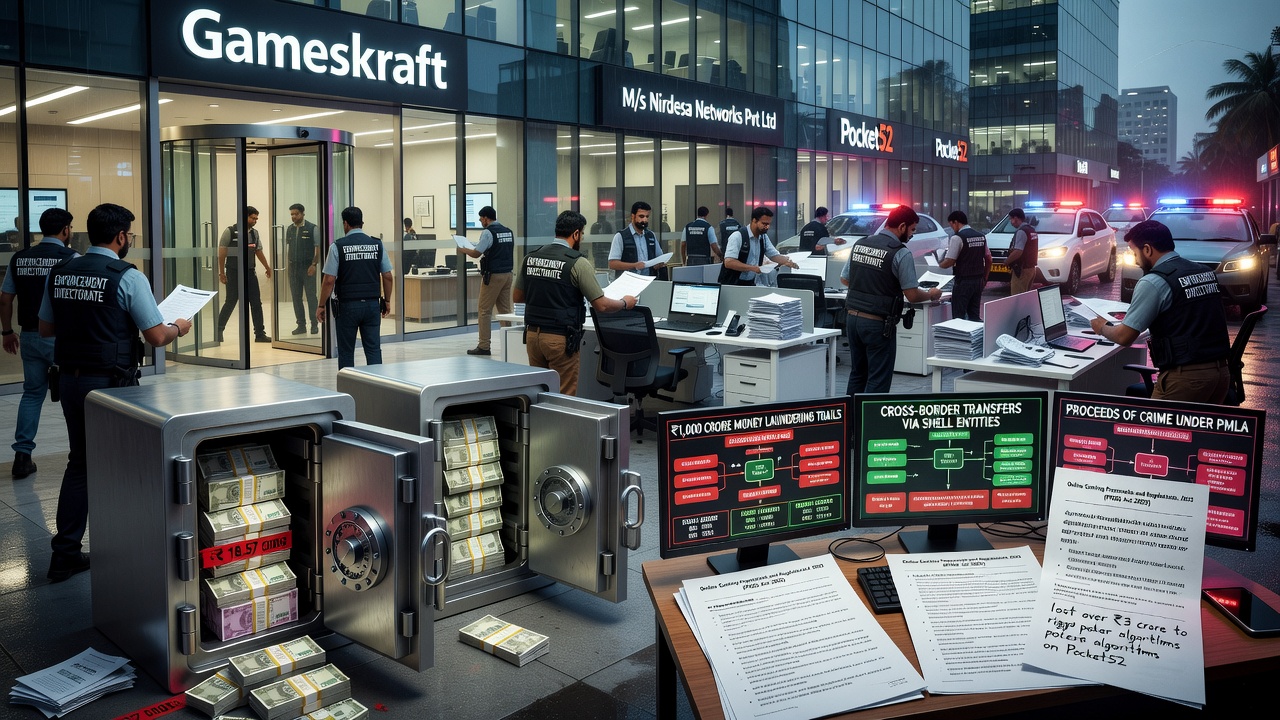
The Enforcement Directorate carried out coordinated search operations across Delhi-NCR, Bengaluru and other locations on Thursday, May 7, in connection with an alleged ₹1,000 crore money laundering case tied to online gaming and betting activity. The raids, conducted by ED's Bengaluru Zonal Office, targeted M/s Gameskraft Technologies Pvt Ltd, its directors, and several individuals allegedly linked to unauthorised online betting operations. Officials seized documents, digital records and electronic devices as part of a widening probe into how funds moved through gaming platforms and associated financial channels.
This is not ED's first pass at the company. Between November 18 and 22, 2025, the agency had already searched premises linked to Gameskraft and M/s Nirdesa Networks Pvt Ltd in Bengaluru and Gurugram, following FIRs filed by Karnataka Police over alleged fraud on the poker platform Pocket52. Complainants accused the platform of manipulating outcomes, permitting player collusion and restricting withdrawals - allegations that, if substantiated, point to deeper problems in how skill-based real-money gaming products are audited and verified. Unlike games with fixed, publicly understood odds - the way most people encounter what is roulette game in a regulated casino setting - online poker and card platforms rely on proprietary algorithms and matchmaking systems that are far harder for an ordinary user to scrutinise or contest.
One complainant reportedly lost over ₹3 crore, and other users flagged concerns about algorithmic manipulation and opaque gameplay mechanics. According to ED, the company allegedly continued operating and retaining user funds despite restrictions under the Online Gaming Promotion and Regulation Act, 2025 (PROG Act), with more than ₹30 crore still sitting in escrow accounts rather than being returned to affected users.
Why Escrow Accounts Are at the Centre of the Case
Escrow arrangements exist precisely to protect user funds - money deposited by players is meant to sit in a segregated account, insulated from the operator's general business finances, until legitimately withdrawn or spent. When regulators freeze such accounts, it usually signals suspicion that the segregation was compromised or that funds were commingled with proceeds linked to unlawful activity. ED has frozen eight escrow accounts holding roughly ₹18.57 crore, treating the money as suspected proceeds of crime under the Prevention of Money Laundering Act. That framework allows the agency to act independently of the original criminal complaints filed with local police, pursuing the financial trail as a distinct offence.
A Pattern Beyond a Single Platform
The case reflects a broader tension in India's online gaming sector, where the line between skill-based platforms, betting products and unregulated wagering has been legally and politically contentious for years. Multiple FIRs registered locally in Bengaluru were escalated to ED precisely because financial investigators can trace cross-border transfers, shell entities and layered transactions that local police units are not equipped to pursue. For platforms operating in this space, the episode underscores that regulatory exposure does not end with a single enforcement action - parallel investigations into different products under the same corporate umbrella can surface years apart, as seen with the gap between ED's earlier searches and this week's operation.
What It Means for Users and the Industry
For consumers, the case is a reminder that withdrawal restrictions, unclear terms and unresponsive customer support on gaming platforms are not minor inconveniences - they can be early indicators of deeper structural or financial problems. For operators, it reinforces that compliance with escrow rules, transparent game mechanics and responsiveness to regulatory frameworks like the PROG Act are not optional formalities but the basis on which continued operation depends. As India's gaming and betting sector continues to expand, cases like this are likely to shape how aggressively state and federal agencies coordinate on financial oversight going forward.