
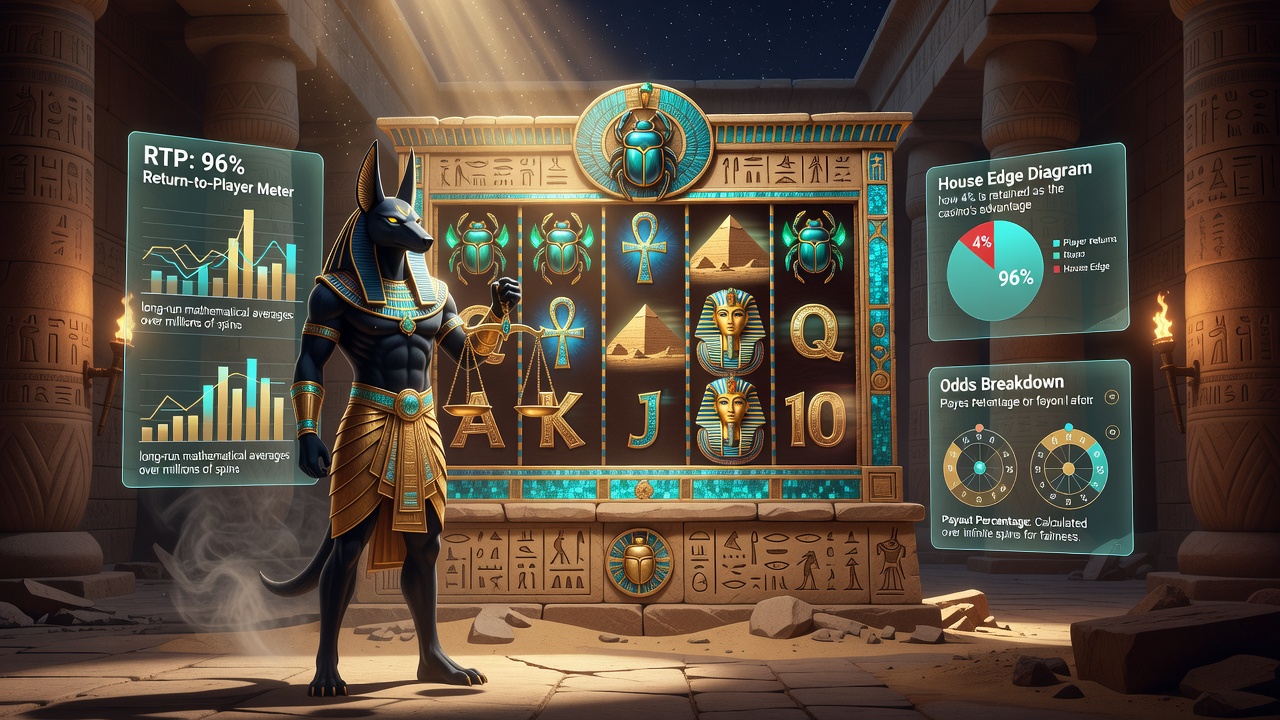
A slot machine with a 96% return figure still loses money for the vast majority of players who sit down for a single session. That single fact trips up more slot enthusiasts than any bonus round or wild symbol ever could. Return to player is a long-run mathematical average, not a promise, and confusing the two leads to disappointment, poor bankroll decisions, and unrealistic expectations about what a game like Anubis Wrath can actually deliver.
This piece breaks down exactly what the Anubis Wrath RTP means, how it's calculated, and why the number printed in the paytable rarely matches what you'll experience in a two-hour session. We'll also look at the anubis wrath slot odds behind individual symbol combinations, the volatility profile that shapes your swings between wins and dry spells, and how the payout percentage interacts with bet size, bonus features, and session length. If you've ever wondered why one player walks away with a jackpot while another burns through their balance on the same machine, the mechanics explained here will clarify it. For readers who want to see the mechanics in action, the anubis wrath rtp details are also available directly through the game's official promo page, alongside the current payout structure and feature breakdown.
What RTP Actually Means in Slot Games
The Mathematical Definition
Return to player is expressed as a percentage representing the theoretical amount a slot machine pays back to players over an extremely large number of spins - typically millions, not hundreds. If a game carries a 95.5% RTP, the math says that for every $100 wagered across that massive sample, $95.50 returns to players collectively. The remaining $4.50 constitutes the house edge, the mathematical margin that keeps casinos operating.
Why RTP Is Never a Session Guarantee
Here's where most players get it wrong: RTP says nothing about what happens in your next 100 spins. Variance dominates short-term outcomes far more than the payout percentage does. You could spin a 97% RTP game for an hour and lose your entire balance, or you could hit a bonus round in your first ten spins and double your money on a game with a lower published return. The percentage only becomes meaningful across a sample size no individual player will ever personally reach.
How Anubis Wrath RTP Compares to Industry Standards
Most licensed online slots fall somewhere between 94% and 97% RTP, with a smaller number of high-variance titles dipping lower and a handful of low-volatility games pushing above 97%. The anubis wrath slot RTP sits within this expected competitive range, positioning it neither as an outlier of generosity nor as a stingy outlier. Understanding where a game lands relative to this band helps set realistic expectations before you ever place a bet.
- Industry average RTP for online video slots: roughly 94%-97%
- Land-based slot machines typically run lower, often between 85%-92%
- Games with progressive jackpots usually sacrifice base RTP to fund the jackpot pool
Breaking Down Anubis Wrath Slot Odds
Symbol Frequency and Reel Weighting
Slot odds are governed by how symbols are weighted across the virtual reels, a detail invisible to the player but coded into the game's random number generator. High-paying symbols - typically the thematic icons tied to Egyptian mythology in a title like this - appear less frequently than low-paying card symbols. This weighting is what creates the tension between chasing big wins and accumulating smaller, steadier payouts.
Paylines, Ways-to-Win, and Their Effect on Odds
Whether a slot uses fixed paylines or a "ways-to-win" mechanic changes the practical odds of landing a payout on any given spin. More ways to win generally means more frequent small hits, while fixed, lower payline counts often correlate with higher volatility and rarer, larger wins. Anubis Wrath slot odds reflect whichever structure the developer chose, and that structure directly shapes how often you'll see your balance move.
Bonus Feature Trigger Rates
Free spin rounds, multipliers, and expanding wilds don't trigger at a flat, guaranteed rate - they're built into the same probability engine as the base game. A bonus that triggers once every 100 to 200 spins on average will feel rare in a short session but arrives reliably over the long run. Knowing this helps explain why some sessions feel feature-starved while others seem to trigger bonuses back-to-back.
Understanding the Anubis Wrath Payout Percentage
How Payout Percentage Differs From RTP
These two terms get used interchangeably, but there's a subtle distinction worth knowing. RTP is the theoretical long-run figure baked into the game's programming. Payout percentage sometimes refers to the actual, audited return observed over a specific real-world period at a given operator - a number that can drift slightly from the theoretical RTP due to sample size and the mix of bets placed by real players.
Fixed vs. Variable Payout Structures
Some slots run a single, fixed RTP regardless of bet size or game mode. Others offer variable RTP settings, sometimes adjustable by the operator within a licensed range, or altered based on whether a bonus buy feature is used. Checking whether Anubis Wrath payout percentage is fixed or variable matters if you're comparing your experience across different platforms hosting the same title.
Bet Size and Its Influence on Effective Return
Minimum and maximum bet tiers occasionally carry different RTP values on certain slot titles, a detail casual players rarely check. A game might offer a slightly higher return at maximum bet, rewarding higher stakes with marginally better long-term odds. This doesn't guarantee anything in a single session, but across extended play, it can shift the math in your favor or against it.
Anubis Wrath Return to Player: Reading the Real Numbers
Where to Verify the Official RTP Figure
Reputable slot developers publish RTP figures either directly in the game's information screen or through the licensing authority's public records. Before relying on any third-party claim about anubis wrath return to player, check the in-game paytable or the official operator page - these sources reflect the audited, certified figure rather than an estimate.
Variance and Volatility: The Companion Metric to RTP
RTP tells you how much comes back over time; volatility tells you how it comes back. A high-volatility game pays rarely but generously, producing long dry spells punctuated by significant wins. A low-volatility game pays frequently but modestly, smoothing out the experience. Anubis Wrath's volatility profile shapes the practical feel of its return to player figure far more than the percentage alone.
Long-Term vs. Short-Term Player Experience
Two players with identical bankrolls and betting patterns can walk away from the same session with wildly different results, even though both are subject to the same underlying return to player figure. This isn't a flaw in the math - it's the nature of randomness operating over a small sample. Only players who log thousands of spins across many sessions will see their results converge toward the published RTP.
Practical Strategies Based on RTP and Odds
Bankroll Management Aligned With Volatility
Matching your bankroll to a game's volatility profile reduces the odds of going bust before a significant win arrives. High-volatility titles demand a larger buffer and smaller relative bet sizes; low-volatility titles allow for tighter bankrolls since wins arrive more consistently.
Session Length and Realistic Expectations
Short sessions are dominated by variance, not by the RTP figure. Setting a defined loss limit and win target before playing - rather than chasing losses or extending a winning streak indefinitely - keeps the theoretical payout percentage from becoming an excuse for poor discipline.
Comparing RTP Across Similar Titles
Before committing to extended play on any single slot, compare its published return figure against similar titles in the same theme or volatility class. A half-percentage-point difference in RTP sounds trivial but compounds meaningfully across thousands of spins.
- Set a loss limit before you start playing, not after
- Match bet size to bankroll, not to recent wins or losses
- Check RTP and volatility together - one without the other tells an incomplete story
Frequently Asked Questions
Does a higher RTP mean I'm more likely to win on any single spin?
No. RTP reflects the average return across millions of spins, not the probability of winning on your next spin. A high-RTP game can still produce a long losing streak in the short term, since individual spin outcomes are governed by randomness, not by the cumulative percentage.
Can the Anubis Wrath RTP change between different casino platforms?
It's possible if the operator has licensed a variable RTP configuration, though most reputable platforms display the certified, fixed figure. Always check the in-game info screen on the specific platform you're using rather than assuming the number is identical everywhere.
Is a slot with lower volatility always the safer choice?
Lower volatility reduces the size of your bankroll swings and produces more frequent small wins, which suits players prioritizing longer playtime over big payouts. It isn't inherently "safer" in terms of total losses - it simply distributes wins and losses differently across a session.
How many spins does it take for RTP to become accurate?
Meaningful convergence toward the published RTP typically requires tens of thousands of spins, far beyond what a typical recreational session includes. This is why short-term results can look wildly inconsistent with the advertised percentage.
Does using a bonus feature change the game's payout percentage?
Some slots adjust their effective RTP slightly when a bonus buy or feature purchase option is used, since that mechanic skips the base game entirely. Check the paytable for separate RTP listings if the game offers this kind of purchasable feature.
Where can I find the official, audited RTP figure for a slot?
The most reliable sources are the game's built-in information screen, the software provider's official documentation, or the licensing authority's public game registry. Third-party estimates found elsewhere should be treated as unverified until confirmed against one of these primary sources.