
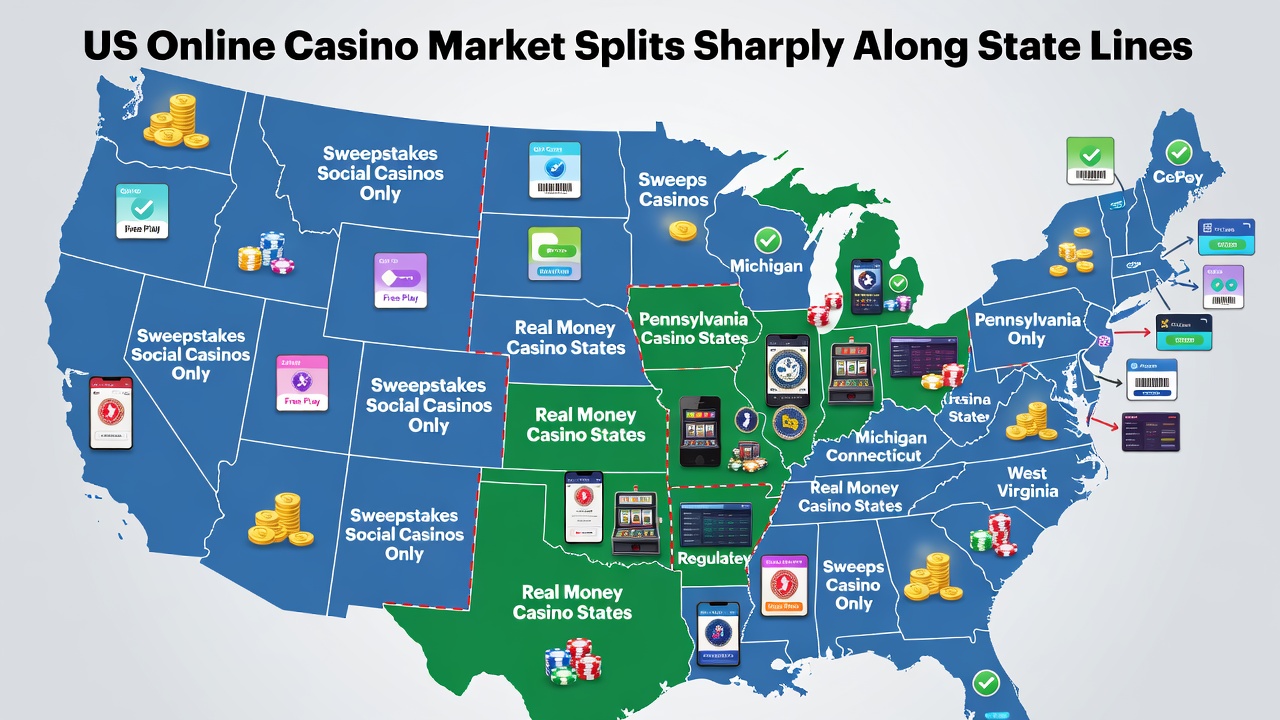
Where a player lives determines which kind of online casino they can legally use in the United States, and the gap between those two worlds is widening rather than closing. Real money casino play remains confined to five states - New Jersey, Pennsylvania, Michigan, Connecticut and West Virginia - while everywhere else, sweepstakes-style social casinos have become the default substitute. That split shapes almost every decision an operator makes, from how it structures a welcome offer to which state lines it draws around eligibility.
Why the Market Is Divided
Online casino gambling for real money requires state-by-state licensing, and only a handful of legislatures have approved it. Sports betting expanded far faster after the 2018 federal shift that opened the door to state-level regulation, but online casino products have moved more slowly, partly because they raise different concerns around problem gambling and partly because land-based casino interests in many states have resisted competition from digital platforms. The result is a patchwork: five states with regulated, licensed real money casino operators, and the rest of the country left without a legal path to wager actual cash online.
Social casinos fill that gap through a different legal structure. Players use virtual currency, often called Gold Coins, for standard play, and a separate currency, typically Sweeps Coins, can sometimes be redeemed for cash prizes or gift cards. Because no purchase is required to obtain Sweeps Coins, these platforms generally operate outside the licensing regimes that govern real money gambling. It is a meaningfully different product, not simply a workaround, and it should not be mistaken for a regulated casino experience.
How Welcome Offers Actually Work
Bonus structures across both categories vary more than marketing copy suggests. Some operators front-load value through a single deposit match, others spread spins across days or weeks, and a smaller group leans on lossback protection that returns a portion of early losses as credit. None of these mechanisms change the underlying math of the games themselves - house edge persists regardless of how a bonus is packaged. Wagering requirements, expiry windows and game restrictions determine whether a bonus has practical value, and those terms differ enough between operators that reading the fine print matters more than the headline figure.
- Deposit matches require turning over bonus funds before withdrawal, often at specified multiples.
- Spins distributed over multiple days require daily login or opt-in, and unclaimed spins can expire.
- Lossback offers typically apply only within a narrow window, often the first 24 hours.
What This Means for Players
Age and location verification sit at the center of both markets. Real money platforms require players to be 21 or older and physically located within a licensed state, confirmed through geolocation technology that operators must maintain as a condition of licensing. Social casinos set a lower bar, 18 and up, and are generally available nationwide, though individual states can and do restrict specific platforms. Players should treat eligibility rules as firm rather than approximate, since violations can affect account standing and any pending redemptions.
The distinction between the two categories carries weight beyond legal technicality. Real money platforms are subject to state oversight covering fund segregation, responsible gambling tools and advertising standards. Social casinos operate with less uniform regulatory scrutiny, which places more responsibility on the player to understand redemption terms before assuming coins carry cash value. Anyone spending meaningful time or money on either type of platform should treat it as entertainment with real limits, not a reliable source of income, and should use available deposit limits, self-exclusion tools or cool-off periods where offered.