
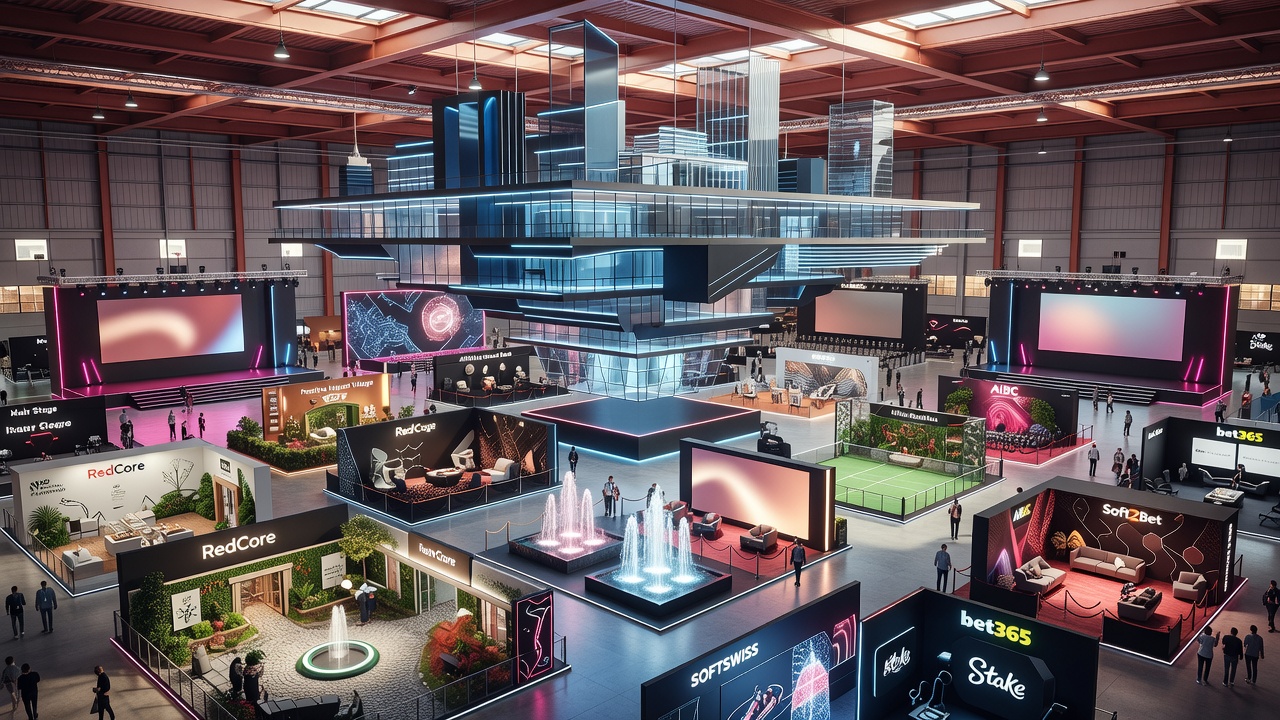
Ten days before a single delegate badge gets scanned, more than 7,000 stand builders and event professionals will already be inside Fiera Roma, assembling over 1,000 stands across nine halls. When SiGMA World opens on 2 November, that construction site becomes a 120,000 sqm venue roughly equivalent to seventeen football pitches, hosting what has become one of the gambling and gaming industry's largest annual gatherings. The 2026 edition runs under sponsorship from RedCore and is expected to draw more than 30,000 delegates and over 1,200 sponsors and exhibitors to the Italian capital.
One Venue, Four Industries, No Single Starting Point
What distinguishes this event from a conventional trade show is its structure. SiGMA, Affiliate Grand Slam, AIBC and FX World operate side by side under one roof, each retaining its own identity while sharing physical proximity. Hall 3 anchors SiGMA's core B2B and B2C activity around the Main Stage, with sessions ranging from international expansion to regulation and compliance. Hall 5 introduces a new Italy Stage this year, reflecting the host market's growing regulatory and commercial weight rather than treating it as a backdrop. Hall 2 belongs to Affiliate Grand Slam, Hall 7 to AIBC's focus on artificial intelligence, blockchain and crypto, and Hall 8 to the Global Finance Stage covering FX, fintech and payments.
This layout matters commercially. Affiliates, payment providers and technology suppliers increasingly operate across sector boundaries, and a venue that keeps specialist tracks within walking distance of each other reflects how converged these industries have become - particularly as payments infrastructure, affiliate marketing rules and gambling compliance now intersect more directly than they did a decade ago.
Exhibition Design as a Competitive Signal
Booth construction at this scale has become a marketing exercise in its own right. Previous editions saw exhibitors build immersive environments - courtyards, themed architecture, working fountains - turning stand design into a differentiator separate from the products being pitched. This year's addition of the Positive Impact Village, co-hosted by the SiGMA Foundation, places social-impact initiatives from charities, NGOs and corporate CSR programmes directly on the show floor in Hall 5, alongside commercial exhibitors rather than in a separate space. Given that gambling operators face growing scrutiny over advertising practices and player protection, visible commitments to social responsibility carry more weight when positioned within the main commercial environment rather than apart from it.
Business Programming Built Around Breaks, Not Just Panels
The event's informal spaces - padel courts, a go-kart track sponsored by SOFTSWISS, food courts, lounges operated by companies including Stake, bet365 and Soft2Bet - are not incidental. Large B2B events increasingly treat networking infrastructure as seriously as the conference agenda, recognising that deals and partnerships often form outside formal sessions. With five stages and more than 550 speakers running concurrently, overlap is inevitable, and tools such as the SiGMA Match app exist specifically to help delegates prioritise meetings across a floor plan too large to cover on foot in four days.
For an industry under continuous regulatory pressure around licensing, advertising standards and consumer protection, events of this scale also function as a barometer. The balance between commercial exhibition space and dedicated areas for compliance, finance and social impact signals where the sector believes its reputational and operational priorities currently lie.