
One wrong tap separates a modest payout from a total loss - that single fact defines everything about how this game rewards patience over impulse. A chicken crossing an open lane doesn't care how lucky you felt five rounds ago. It cares about the decision you make in the next half second.
That tension is exactly why so many players return to this title after their first few rounds, hunting for a repeatable method rather than relying on gut feeling. If you're still getting familiar with the mechanics, spending a few minutes with a walkthrough on how to play chicken road 2 before risking real bets will save you from the early mistakes that cost most newcomers their first several attempts. Once the basic rhythm clicks, the game stops feeling random and starts feeling like a series of calculated bets against your own nerve.
This guide breaks down the controls, the underlying logic behind the risk curve, and the habits that separate consistent players from those who cash out too early or push too far. Nothing here relies on luck alone - it's about reading the pattern of the game and matching your decisions to your actual risk tolerance.
Understanding Chicken Road 2 Gameplay
The Core Concept
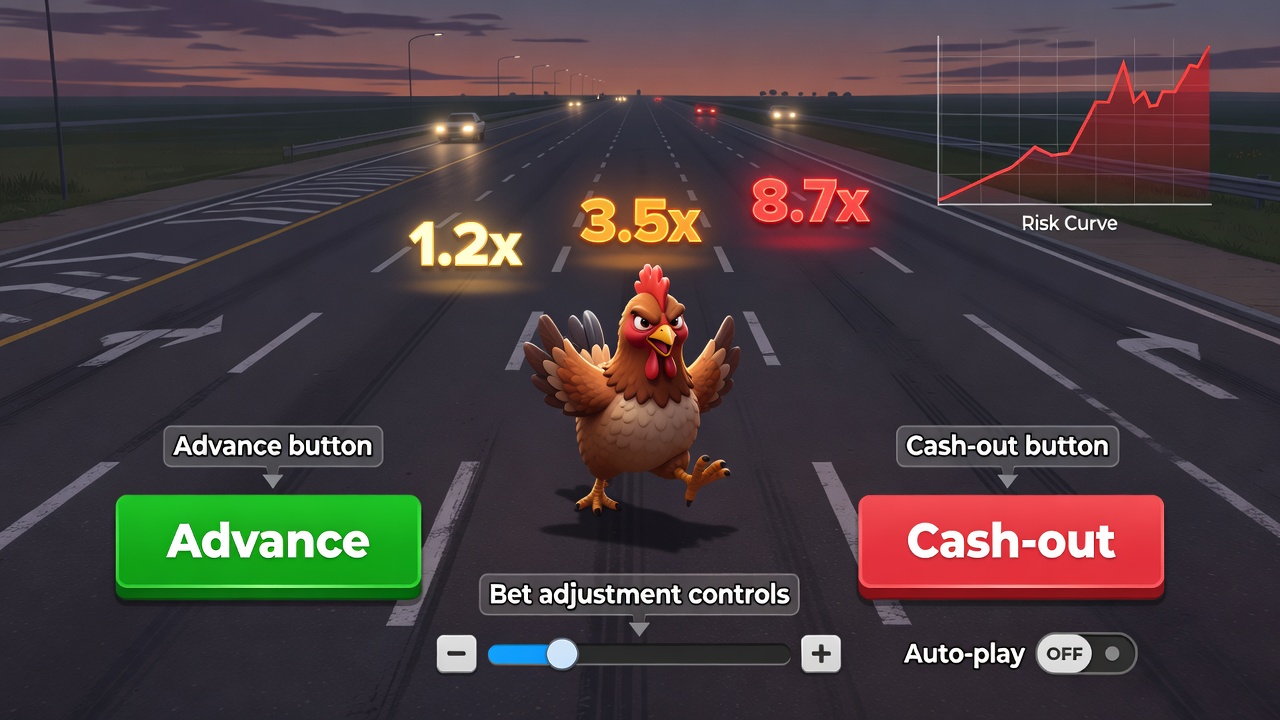
At its foundation, chicken road 2 gameplay revolves around a single decision repeated under increasing pressure: advance or cash out. A chicken moves forward across a series of lanes, and each successful step increases the multiplier attached to your original bet. The longer you push forward, the higher the potential reward - but the higher the chance that the next step ends the round entirely.
How the Risk Curve Escalates
Every lane crossed raises the stakes exponentially rather than linearly. Early steps feel almost safe, with modest multiplier gains and low apparent danger. By the middle stretch, the payout curve steepens noticeably, and the psychological pull to keep going intensifies at exactly the moment the actual risk does too. This asymmetry between perceived and real danger is the single most important thing to internalize before placing a serious bet.
What Makes It Different From Similar Games
Unlike straightforward slot mechanics, this format gives you continuous control over when to stop. There's no spinning reel dictating your fate after the initial bet - you decide, round after round, whether the next step is worth it. That agency is what makes the game replayable and, for many, more mentally engaging than pure chance-based alternatives.
Chicken Road 2 Controls Explained
Basic Input Layout
The control scheme is intentionally minimal. A single primary button advances the chicken to the next lane, while a separate cash-out button locks in your current multiplier and ends the round on your terms. There's no complex menu to manage mid-round - the simplicity is deliberate, keeping your attention on timing rather than interface navigation.
Adjusting Bet Size Before Each Round
Before the chicken starts moving, you set your wager using increment controls, typically presented as plus and minus buttons or a slider. Getting comfortable with these chicken road 2 controls before you start playing for meaningful stakes matters because misjudging your bet size early can throw off your entire session strategy later.
Speed and Auto-Advance Options
Some versions include a faster playback mode or an auto-play setting that removes manual input between steps. These options suit players who've already settled on a fixed strategy and want to execute it quickly, but newer players should avoid them until they've built an instinct for when to stop manually.
- Advance button - moves the chicken one lane forward
- Cash-out button - ends the round and secures current winnings
- Bet adjustment controls - set wager size before each round starts
- Auto-play toggle - automates advancement based on preset rules
How to Play Chicken Road 2 Step by Step
Setting Up Your First Round
Start by choosing a bet size well below your total bankroll - a small fraction, not a significant chunk. This isn't caution for its own sake; it's what allows you to play enough rounds to actually learn the game's rhythm instead of being knocked out after two unlucky attempts.
Reading the Multiplier as You Progress
Each successful advance updates a visible multiplier tied to your stake. Watching how quickly that number climbs, and comparing it to how many lanes you've already crossed, gives you the real-time information needed to judge whether continuing still makes mathematical sense.
Deciding When to Cash Out
This is the actual skill of the game. Cashing out too early leaves value on the table repeatedly across a session; waiting too long turns a winning round into nothing. Anyone learning chicken road 2 how to play effectively needs to treat this decision as the entire game, not a side detail - everything else is just setup for this one moment.
Ending a Session Responsibly
Set a target and a limit before you start, not after a losing streak. A predefined stopping point, whether it's a win threshold or a loss ceiling, keeps a single bad stretch from turning into a much larger one.
Essential Chicken Road 2 Tips for Beginners
Start With Smaller Bets to Learn Pacing
New players consistently overestimate how far they'll push forward and underestimate how quickly the risk curve turns against them. Smaller bets let you make that mistake cheaply while you're still building intuition.
Watch the Pattern, Not Just the Payout
Rather than fixating on the multiplier number alone, pay attention to how the round unfolds - how many lanes typically get crossed before a loss occurs in your recent sessions. This observational habit is one of the most overlooked chicken road 2 tips, and it costs nothing to apply.
Avoid Chasing Losses Immediately
A losing round doesn't mean the next one owes you anything. Increasing your bet size right after a loss to "make it back" is the fastest route to draining a bankroll in a single session.
Take Breaks Between Sessions
Fatigue erodes judgment faster than most players realize. Stepping away for even a few minutes after a stretch of rounds resets your decision-making and keeps impulsive cash-out timing from creeping in.
Advanced Chicken Road 2 Strategy
Setting a Personal Multiplier Ceiling
Experienced players often commit to a fixed multiplier target before the round even starts - for example, deciding in advance to cash out once a certain threshold is reached, regardless of how tempting it is to push further. This removes emotion from the decision entirely.
Bankroll Segmentation Across Sessions
Dividing your total bankroll into fixed session amounts prevents one bad run from affecting your entire budget. Each segment operates as its own contained experiment, win or lose.
Balancing Aggressive and Conservative Rounds
A sound chicken road 2 strategy alternates between higher-risk rounds meant to build bigger returns and conservative rounds designed simply to preserve capital. Running every round at maximum risk guarantees an eventual wipeout; running every round too cautiously limits your upside unnecessarily.
Tracking Your Own Results Over Time
Keeping a simple record of bet size, cash-out point, and outcome across sessions reveals patterns in your own behavior that are invisible in the moment. Most players who improve significantly do so by studying their own decisions, not by finding a hidden trick in the game itself.
- Decide your cash-out multiplier before the round begins
- Split your bankroll into separate, limited sessions
- Mix conservative and higher-risk rounds deliberately
- Log outcomes to spot your own recurring mistakes
Common Mistakes That Cost Players Their Winnings
Ignoring the Escalating Risk Curve
Treating lane ten the same as lane two is a fundamental misread of the game's structure. The math changes with every step, and your decisions need to change with it.
Playing Without a Predetermined Limit
Entering a session with no stopping point set turns a strategic game into pure impulse. This single oversight undermines every other tip discussed here.
Overusing Auto-Play Without Adjustment
Auto-play features are useful once your strategy is fixed, but leaving them running unmonitored ignores the fact that no static rule performs well across every possible round outcome.
Frequently Asked Questions
Is there a way to guarantee a win in Chicken Road 2?
No. The game is built on probability, and no control input or timing trick removes that underlying uncertainty. What you can control is how you manage bet size and when you choose to stop, which affects your long-term results far more than any single round's outcome.
How much should I bet per round as a beginner?
Keep individual bets to a small percentage of your total session bankroll, often cited around one to five percent depending on how many rounds you want to play. This lets you absorb a few losses without ending your session prematurely.
What's the biggest difference between casual and strategic play?
Casual players react round by round based on how they feel; strategic players set rules in advance - bet limits, cash-out thresholds, session boundaries - and follow them regardless of short-term emotion.
Should I use auto-play as a new player?
It's better to avoid it initially. Manual play forces you to actually observe the risk curve and build real judgment, which auto-play settings bypass entirely.
How do I know when to stop for the day?
Set both a win target and a loss limit before you start playing. Once either threshold is hit, stop - regardless of how the last few rounds felt, since recent results have no bearing on future ones.
Does session length affect my odds?
No, each round operates independently of how long you've been playing. Session length mainly affects your judgment and fatigue level, not the actual probability of any given round's outcome.