
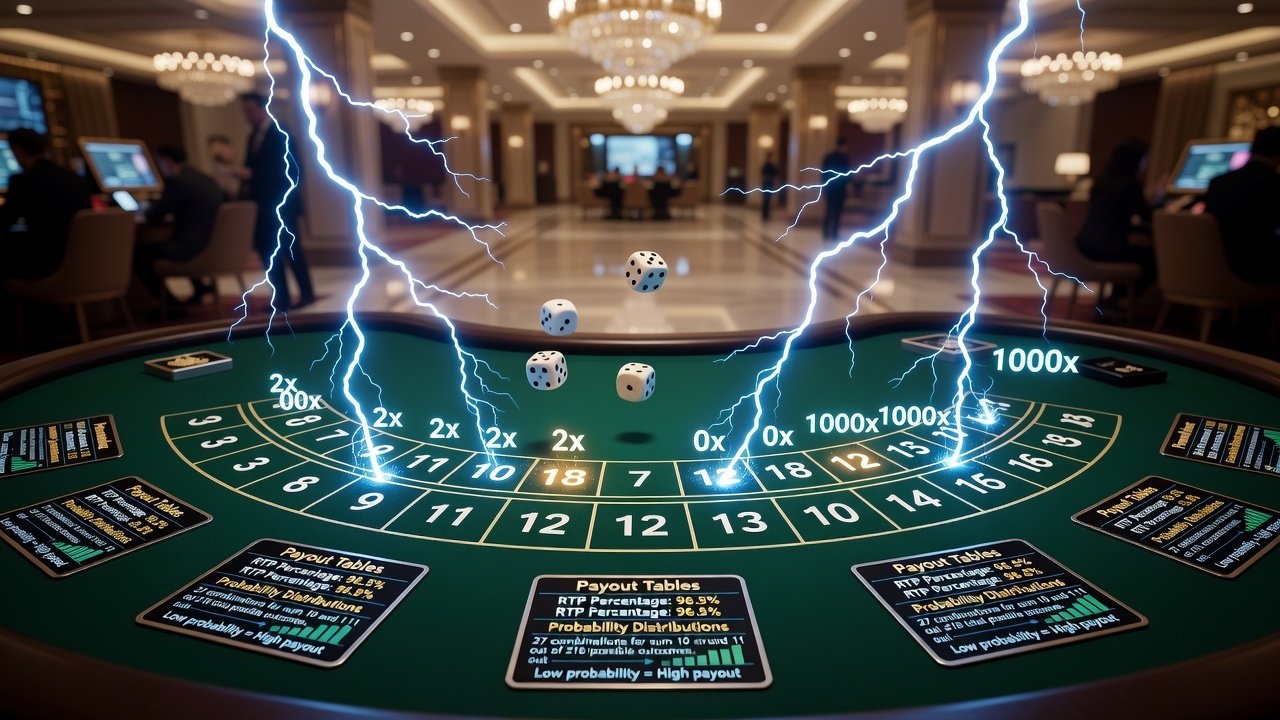
A single roll of three dice can multiply a bet by up to 1,000 times its original value, yet most players walk away without understanding why that number appears so rarely. The mechanics behind that gap between theoretical possibility and practical experience separate players who manage their bankroll intelligently from those who chase a jackpot that mathematics says will barely visit them.
Lightning Dice sits at an odd intersection of pure chance and dynamic multipliers, borrowing structure from craps-style totals while layering in randomly generated bonus numbers that spike payouts unpredictably. Anyone serious about the game needs to separate marketing language from the actual arithmetic driving each round, and one of the clearest breakdowns of lightning dice payouts can be found by comparing published odds tables against real session data rather than relying on gut feeling. That comparison reveals patterns most players never notice until they've lost several sessions guessing at probabilities instead of calculating them.
This piece walks through the full payout architecture: how the return to player percentage is calculated, why betting odds shift depending on which total you back, how the lightning multiplier alters expected value on a given round, and what all of this means for a player deciding where to place chips. No fluff, no false promises - just the numbers and the logic behind them.
How Lightning Dice Payouts Actually Work
Lightning Dice payouts are built on a simple foundation: three standard six-sided dice are rolled, and players bet on the sum of all three, which ranges from 3 to 18. Each possible total carries a fixed base payout determined by how statistically likely that total is to appear. What complicates the picture - and what gives the game its name - is a random lightning round mechanic that strikes select numbers with multipliers before the dice are thrown, temporarily boosting the payout on those specific totals.
The Basic Dice Roll Mechanic
Before any multiplier is applied, the base game functions like a straightforward totals bet. Three dice generate 216 possible combinations, but because multiple combinations produce the same sum, totals near the middle of the range (10 and 11, for example) occur far more often than extreme totals like 3 or 18. This distribution is the backbone of every payout figure in the game - it is not arbitrary, and it does not change round to round.
Base Payout Structure Before Multipliers
Because middle totals appear more frequently, their base payouts are lower. Extreme totals, which are mathematically rare, carry payouts that can reach into the hundreds. This inverse relationship between probability and payout size is standard across nearly all totals-based dice games, and Lightning Dice follows that convention closely before any bonus multiplier enters the picture.
Where the "Lightning" Multiplier Comes In
Ahead of each roll, a random number generator strikes between one and five numbers on the betting board with multipliers, commonly ranging from 2x up to 1,000x. These are not guaranteed to land on the number you've bet on, and they are not guaranteed to appear at all every round. When a struck number is the one rolled, the payout for that specific bet is multiplied accordingly, creating the game's signature large wins.
- Base payouts are fixed and based purely on the statistical frequency of each total.
- Lightning multipliers are applied randomly before the roll, independent of player betting patterns.
- A multiplier only pays out if the struck number matches the actual dice total rolled.
Understanding Lightning Dice Return to Player
Return to player is the long-run percentage of all wagered money that a game is designed to pay back to players over an extended number of rounds. It is not a promise about any single session - it is a statistical average that only becomes meaningful across thousands or millions of rolls. Lightning Dice return to player figures typically fall within a range comparable to other live dealer dice-based games, generally sitting in the mid-90s percentage range, though the exact figure depends on the specific platform and bet type chosen.
What RTP Actually Measures
RTP is a mathematical expectation, not a guarantee for the individual gambler. If a game carries a 95% RTP, the operator's mathematical edge is 5%, meaning that over a very large sample of bets, the house retains that percentage while returning the rest to players collectively. Your specific session could land well above or well below that average - variance is the reason casinos remain profitable while some players walk away winners.
Why RTP Varies by Bet Type in Lightning Dice
Unlike a slot machine with one blended RTP, Lightning Dice return to player figures shift depending on which total you back. Betting on a common total like 10 or 11 produces a different long-run return than betting on an extreme total like 3 or 18, because the lightning multiplier's impact on expected value is not uniform across every number. This makes it essential to check the payout table for each specific total rather than assuming a single RTP applies across the whole board.
How the Lightning Multiplier Affects Long-Term RTP
The multiplier system is designed to add variance without fundamentally breaking the house edge. Occasional massive multipliers create headline-worthy wins, but they are rare enough that they do not meaningfully shift the overall lightning dice RTP percentage upward for the average player over time. The multiplier redistributes when and how big wins occur - it does not eliminate the underlying mathematical structure favoring the house.
Lightning Dice RTP Percentage: What the Numbers Really Mean
Digging deeper into the RTP percentage requires separating theoretical RTP - the number published by the game provider based on simulated or calculated outcomes - from what a player might observe empirically across a limited number of sessions. These two figures converge only with sufficient volume of play.
Theoretical vs. Observed RTP
Theoretical RTP is calculated using the complete probability distribution of dice outcomes combined with the mathematical expectation of the multiplier system. Observed RTP, by contrast, is whatever a specific player or group of players actually experienced over their sessions. Short-term observed RTP can swing dramatically above or below the theoretical figure simply due to normal statistical variance - this is not evidence of a rigged system, just the nature of randomness.
Comparing RTP Across Different Bet Options
Some totals offer marginally better long-term value than others once the lightning multiplier's average contribution is factored in. Players focused on maximizing expected return over time should compare the published RTP for each total rather than betting purely on gut instinct or superstition about "hot" numbers, which have no bearing on independent dice rolls.
Why RTP Alone Doesn't Tell the Full Story
A high RTP figure means little if the payout structure is so volatile that most players run out of bankroll before the long-run average materializes. Variance and RTP need to be considered together - a bet with strong RTP but extreme swings can be riskier in practice than a slightly lower RTP bet with steadier, more frequent payouts.
Breaking Down Lightning Dice Betting Odds
Betting odds in Lightning Dice are dictated entirely by the underlying probability of each dice total, which is fixed and never changes regardless of previous rolls. Understanding these odds is the difference between betting with a clear-eyed view of risk and betting on hope.
Probability Distribution of Dice Totals
With three six-sided dice, sums cluster heavily around 10 and 11, each achievable through 27 of the 216 total combinations - the highest frequency on the board. By contrast, totals of 3 and 18 each occur through only a single combination, making them the rarest outcomes and explaining their dramatically higher base payouts.
How Odds Translate Into Payout Size
The relationship is inverse and consistent: the lower the probability of a total occurring, the higher its base payout multiplier. This is standard actuarial logic applied to a betting game - operators price each bet according to true probability, then build in their margin through slightly reduced payouts relative to the mathematically "fair" odds.
Common Misreadings of Betting Odds
Players sometimes assume that because a number hasn't appeared in several rounds, it is somehow "due." Dice have no memory. Each roll is an independent event, and lightning dice betting odds for any given total remain exactly the same on every single roll, regardless of recent history.
- Totals of 10 and 11 offer the highest probability but the lowest base payouts.
- Totals of 3 and 18 offer the lowest probability but the highest base payouts.
- Past results have zero influence on the odds of future rolls.
Decoding the Lightning Dice Payout Multiplier
The payout multiplier is the feature that generates the game's most dramatic outcomes, and understanding how it is generated helps set realistic expectations rather than chasing the rare maximum hit.
How Multipliers Are Randomly Assigned
Before each round's dice are rolled, a random generator selects a handful of numbers on the board to receive a multiplier boost, with values that can range from small enhancements up to the game's advertised maximum. This selection happens independently of betting activity and independently of prior rounds, meaning no pattern exists for players to exploit.
Maximum vs. Typical Multiplier Values
Headline maximum multipliers - often reaching into the hundreds or even four figures - are rare by design. The vast majority of struck numbers in any given session receive modest multipliers, and the appearance of a maximum-value strike combined with a matching dice roll is a genuinely low-probability event.
Strategic Considerations Around Multiplier Timing
Because multipliers are struck before the dice are rolled and are visible to players, some choose to place additional bets on numbers that have just received a boost. This does not change the underlying probability of that number appearing - it simply increases the potential payout if it does. Treating a struck multiplier as a signal of increased likelihood is a common but mathematically unfounded assumption.
Maximizing Value From Lightning Dice Game Payouts
Combining an understanding of RTP, odds, and multipliers allows a player to approach each session with a coherent strategy rather than relying purely on instinct.
Balancing Risk and Reward Across Bet Types
Spreading bets across a mix of high-probability, low-payout totals and low-probability, high-payout totals can smooth out variance while still leaving room for a larger win. This approach doesn't change the house edge, but it does affect the shape of a player's bankroll swings over a session.
Bankroll Management Given the Game's Volatility
Because multiplier-driven wins are infrequent, setting a fixed loss limit and win target before playing helps prevent the common trap of chasing a multiplier that statistically may not appear for many rounds. Session-based budgeting matters more in a high-variance game like this than in steadier, lower-volatility formats.
Reading Payout Tables Before You Bet
Every reputable version of the game publishes its base payout table clearly. Reviewing it before placing chips - rather than relying on memory or assumption - ensures bets align with actual current lightning dice game payouts rather than outdated or misremembered figures.
Frequently Asked Questions
Is Lightning Dice purely luck, or is there skill involved?
The dice outcomes themselves are entirely random and cannot be influenced by skill. The only decision a player controls is which totals to bet on and how much to wager, which is where bankroll management and odds awareness make a practical difference.
Why did I lose several rounds in a row despite favorable odds?
Short-term results routinely deviate from long-run probability due to normal variance. A handful of losing rounds, even on statistically favorable bets, is entirely expected and doesn't indicate anything unusual about the game's fairness.
Does betting on multiple totals at once improve my chances?
Betting on more totals increases the frequency of smaller wins but does not improve the overall mathematical edge, since the combined house advantage across your bets remains the same. It changes the pattern of outcomes, not the underlying expected value.
Are the lightning multipliers more likely to hit certain numbers?
No. The random generator that assigns multipliers to numbers on the board operates independently of dice probability and historical patterns, so no total is inherently favored to receive a multiplier over another.
How can I check the actual RTP for a specific bet before playing?
Reputable platforms publish detailed payout and RTP tables for each individual total, usually accessible through the game's information or help section. Reviewing this table before betting is the most reliable way to compare expected returns across different totals.
Can the house edge change during a live session?
No. The base house edge built into each total's payout remains fixed regardless of how the multiplier feature performs on any given round. Multipliers add variance to individual outcomes but do not restructure the underlying mathematical edge of the game itself.